The butterfly is to Zhuangzi what the madeline is to Proust’s In Search of Lost Time (or linen is to Marx’s Capital); it’s the reference everyone is eager to make, to signal that they are in the know…but it actually appears quite early on!

everything i read in january 2026
what Substack can learn from James Joyce ✦ philosophy from Bergson to Zhuangzi ✦ and essays/paintings worthy of sustained attention
6
Bergson, who won the Nobel Prize in literature in 1927, wrote beautifully about the role that intuition could play in a scientifically-oriented society. And he was well-known—like his second cousin by marriage, Marcel Proust—for his writings on time, memory, and consciousness.
In 1904, Bergson wrote to Proust: “I believe, as you do, that every form of art sets out to convey certain states of mind that would be inexpressible in any other language: that is the raison d’être of that art.”
Today, Proust is a household name, while many people are unfamiliar with Bergson. But for much of their lives, the situation was quite different:
While Bergson had reached almost unfathomable levels of notoriety, Proust was still making his way towards literary icon status. In the final months of 1913…[Proust] had just suffered the sting of several rejections and had to resort to self-publishing the first volume of one of the twentieth century’s most imposing literary monuments, In Search of Lost Time.
A long sentence, but whom among us (assuming the ‘us’ is composed of mostly Proust fans) does not love a long sentence…and there are so many exciting alliterative pairs here! Lurk/lilt; marrow/margins; corrupting/collapsing…
we've created a society where artists can't make any money
on artistic innovation, cultural stagnation, and the decline of Silicon Valley intellectualism
2
It doesn’t help that EA is associated with awkward AI engineers and egocentric Silicon Valley nerds. To people outside the tech industry, effective altruism appears passé and essentially cringe. The rationalist blogosphere it grew out of looks even more embarrassing. It’s hard to take rationalists seriously—when one of their near-canonical founding texts is a digressive, 660,000-word Harry Potter fanfiction (about half the length of Proust) where Bayesian reasoning and magical powers are on equal footing.
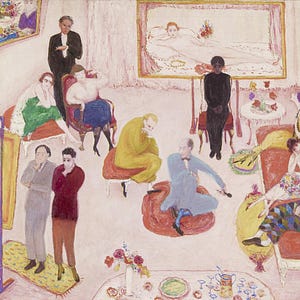
Inherit wealth. The preferred path for many modernists, like Marcel Proust (who inherited around €4.5 million when his parents passed away) and Gertrude Stein (she and her brother shared a trust fund worth 8,000 francs in 1904).4 The artist Florine Stettheimer also came from a wealthy family, and painted many of her works while living in the luxurious Alwyn Court apartments, one block south of Central Park.5
best books, essays, and poems of 2025
an invitation to read more in the new year ✦
2
Vladimir Nabokov called Proust’s enormous novel sequence In Search Of Lost Time “a treasure hunt where the treasure is time and the hiding-place the past.” Something of the same quest is enacted in this excerpt from the great Pakistani writer Mushtaq Ahmed Yousufi’s novel Mirages of the Mind.
@aria’s ‘Waiting for Your Call’ (2021), which has an extraordinary opening line—I love how easily she evokes the atmosphere that the poem takes place in, using 2 words that aren’t typically used to convey visual information (‘retreat,’ ‘generous’):
The light retreats and is generous again.
No you to speak of, anywhere—neither in vicinity nor distance,so I look at the blue water, the snowy egret, the lace of its feathers
shaking in the wind, the lake—no, I am lying.There are no egrets here, no water. Most of the time,
my mind gnaws on such ridiculous fictions…
For the Proust fans, Aber has two poems that touch on him: ‘Zelda Fitzgerald’ (the first Aber poem I read!) and ‘Afghan Funeral in Paris.’
writing is an inherently dignified human activity
the case for starting your own newsletter ✦ and reflections on 2 years, 52 posts, and 31,000 subscribers
3
The case for reading Marcel Proust’s 3,000-page modernist novel, In Search of Lost Time1
Post rarely, but do exceptional work. On YouTube, the foremost practitioner of this strategy is Natalie Wynn. Most channels upload videos weekly; Wynn posts 1–2 video essays a year on ContraPoints. @Henrik Karlsson, who writes one of my favorite newsletters, has observed that “When I have a slower publishing cadence my blog grows faster”:
When I started writing online, the advice I got was to publish frequently and not overthink any single piece…I’ve now written 37 blog posts and I no longer think this is true. Each time I’ve given in to my impulse to “optimize” a piece it has performed massively better (in terms of how much it’s been read, how many subscribers it’s generated, and, most importantly, the number of interesting people brought into my world).
It’s worth nothing that my 3rd most popular post, no one told me about proust, took 18 hours to write.
Need a little more encouragement to take on the daunting (but profoundly rewarding) project of reading Proust? Try reading @Nabeel S. Qureshi’s Proust post, or Jonah Weiner—one-half of the cult-favorite fashion newsletter, @Blackbird Spyplane—on Proust:
everything i read in october & november 2025
do you really need to read all the books you buy? ✦ plus reviews of 2 excellent debut novels ✦ an Italian novella about rogue AI ✦ and an attempt to "read" "theory"
3
And of course I loved her essay on the late, great Eve Kokofsky Sedgwick’s essay collection, The Weather in Proust, which was first published in LARB. (If Proust is mentioned in the first 20 pages of a book, I’m almost guaranteed to finish it! Other books in this category: Jacqueline Harpman’s I Who Have Never Known Men, Daša Drndić’s EEG—where a character is likened, disparagingly, to Madame Verdurin—and Sally Mann’s Art Work The nice thing about reading Proust is that it serves as a warm introduction to other books—like going to a party alone, but being on intimate terms with the most famous person there, and therefore emboldened to speak to any stranger present.)
But I digress. I also read the literary critic James Wood’s How Fiction Works (where Proust also makes an appearance, but only on page 47). Wood is, perhaps, one of the most famous literary critics of our time—first at The Guardian, then The New Republic (where he famously inveighed against the “hysterical realism” of contemporary novels), and then the New Yorker.
My great success in finally confronting Bourriaud’s Relational Aesthetics helped me approach another unread book in my shelf: Michael Chanan’s From Printing to Streaming: Cultural Production Under Capitalism. Chanan’s book occupies a category that I tend to struggle with: the Marxist theory–laden text, authored by by an Anglophone artist–academic, about art under capitalism. (If a Proust mention in the first 20 pages tends to motivate me onwards…then a Karl Marx and David Harvey and Theodor Adorno and Ludwig Wittgenstein mention in the first 20 pages tends to repel me. And if Mikhail Bakhtin is cited as well? I might never open the book again.)

conversations with friends (on tech, culture, criticism, and bait)
my podcast conversation with the writer and technologist Jasmine Sun ✦
1
I have this Proust newsletter that went viral earlier this year. It’s something like 5,000 words…a lot of people read to the end. I have comments and emails that reference things deep into the post. I feel very strongly that people can read something long-form on their phones, but it’s very easy to get bored. And so a lot of the formatting I do is to [make the post] feel as visually varied as possible. Lists are a nice visual break; block quotes are a nice visual break; having generous images throughout; having a few short paragraphs and a few long ones. Sometimes I see newsletters where I’m like, the content in this is so good, but there are no images. There are no subheadings. There are no little lists…Visual variation is how you get people to read long-form on a screen.
everything i read in june 2025
5 books about design, grief, spirituality and history ✦ and recent films from China, Taiwan and Vietnam
1
In my recent newsletter about Proust, I briefly mentioned a poem by the children’s book author and theatrical poet Ruth Krauss.

annie ernaux fixed my disintegrating attention span
the (almost) definitive ranking of Ernaux's books ✦ everything I read in March, April, and May 2025
1
The Possession (2022) is about Ernaux’s all-consuming jealousy when a former lover (who she left, after 6 years together) begins a relationship with someone new: a 47 year old professor, divorced, with a young son. When the former lover tells Ernaux this, she—burdened with these biographical details—becomes obsessed with learning more about this woman. What does she look like? Where does she teach? What is her life like? “The strangest thing about jealousy,” Ernaux writes, “is that it can populate an entire city—the whole world—with a person you may never have met.” If you are given to stalking your exes (or your ex’s exes, or your partner’s exes) on social media, this could be a very cathartic read! Or if you liked vol. 5 and 6 of In Search of Lost Time, which describe the protagonist’s obsessive, neurotic jealousy that his loved one might be seeing others. But I—despite being an exceptional, world-class ruminator—don’t really look people up on social media like that, so I couldn’t get into The Possession! Especially since there is much less about class, gender, and French history compared to her other books.
no one told me about proust
on poptimism and literary snobs ✦ and why taste is cultivated through love, not education
32
In 2022, I decided to spend the year reading Marcel Proust’s In Search of Lost Time. At the time, I knew nothing about Proust:
I'd left college without taking a single literature class. Instead, I learned how to program and use Photoshop. So no one told me—I’d somehow missed this!—that In Search of Lost Time was a masterpiece of modernist literature. (I didn’t know what modernist literature was, either.) No one told me that it was famously difficult and exhausting to read. All I knew was that Lydia Davis—the queen of the very short story, the grand dame of American flash fiction—had once said:
I read Proust because I wanted to understand what Lydia Davis saw in him. And from the very first page—with that deceptively, winsomely ordinary beginning: For a long time, I went to sleep early—I was charmed:
For the next 291 days, the novel accompanied me everywhere. I brought vol. 1, The Way By Swann's, on a train from San Francisco to Los Angeles; and when I needed a reprieve from Charles Swann’s obsession with Odette de Crécy (one of the most successful sugar babies in the literary canon), I would rest my eyes by looking out into the arid Californian landscape, which was now layered over with scenes from Madame Verdurin’s salon, where Swann and his lover would meet. I brought vol. 4, Sodom and Gomorrah, on a vacation to Milan—and, lying awake after my friends had gone to sleep, I would indulge in Proust's descriptions of the night:
Everything about In Search of Lost Time was extraordinary—beautiful and funny and remarkable and strange. It was like nothing I had ever read before. I was enthralled. I was also upset. Why had no one told me that Proust would be like this?
I pulled Swann’s Way off the shelf, read the first paragraph, and was astonished. Its obsessive attention to memory, time, and the minutiae of experience as it occurs through thinking—it was not just good. It was, as they say, extremely my shit. Everyone says you should read Proust, but no one had ever told me that I, specifically, should read Proust.
There are two distinct periods of my life: Before Proust and After Proust. After Proust I was no longer someone who merely read books; I was obsessed with them. I couldn't stop talking about Proust! He was the friend I wanted to introduce to everyone I loved; his was the novel where everything important—art, love, friendship, science, beauty, morality, desire—could be found.2
This newsletter is about why you, specifically, should read Proust—but it’s also about why, and how, we ought to approach the literary greats.
In this post — Elissa Gabbert on Proust ✦ Roger Shattuck, Proust’s Binoculars ✦ @Henry Begler on poptimism ✦ W. David Marx on cultural decline ✦ @Ottessa Moshfegh on consciousness ✦ Zachary Fine on Schjeldahl ✦ Daisy Alioto on taste ✦ Charles Broskoski on how to change your trajectory
Before Proust, however, I was not someone who read literature. I was suspicious of it and alienated from the entire project of reading the “classics,” the “canon,” the “great books.” Literature, I assumed, was for people who explicitly pursued distinction, who were proud of their elevated taste. I couldn’t relate to this; I believed it was better to be ordinary, virtuous to be humble. (I might have inherited this from my parents, who—after a childhood in communist Vietnam—preferred to live quietly, dress normally, and behave inconspicuously.3)
Before Proust, I assumed that high culture was for snobs, and pop culture was for the people—it was where you actually enjoyed books, films, music, art. And yet. I was reading so many bad books: unsatisfying, superficial, insubstantial.
Snobbery didn’t motivate me; passion did. I wanted to read the books that others loved. It was Lydia Davis’s unyielding love for Proust that convinced me to read him. Reading In Search of Lost Time, I realized that Proust described certain experiences—being conscious, perceiving reality, observing the world, encountering other people—with a kind of trembling, vital energy I had never experienced before. Every page was rich with sensations and ideas—and every I spent reading the novel seemed to overflow with things to savor, because, as Proust wrote in vol. 7, Finding Time Again:
Why had I never read Proust before? Because I was a victim of what @Henry Begler (in one of the best and most invigorating newsletters I’ve read on Substack) has described as a “vulgar poptimism,” where
This was why I clung onto pop culture for so long—because I thought that the “challenging” books (and films, and music, and performances) were less enjoyable. Reading Proust showed me that this was false. The supposedly impenetrable, inscrutable, overtly intellectual works—they were better, not because they offered more cultural capital and clout, but because they made me feel alive.4
The unexpected economy of a Proustian sentence
One of the aesthetic effects that is so distinctively Proustian, so formally masterful and remarkable, is the way in which his sentences leap forward and backwards in time, presenting us with the narrator’s early ignorance and the understanding he attained later on in life. One of the best examples of this appears in vol. 4, Sodom and Gomorrah, when Marcel describes a covert relationship between two men:
Here, Proust has superimposed 3 different moments in time into a single sentence:
Point A, the present moment, where Proust is not aware of the relationship between the chauffeur and his customer, and has not experienced any “misfortunes relative to Albertine”;
Point C, “more than two years later,” when Proust becomes aware of the chauffeur’s relationship with his customer, which could have made a material difference to his romantic life.
The novel is full of these enticing, elliptical sentences—where Proust reveals something, and expresses that, if only he had known this earlier, certain events would have proceeded differently, or with greater understanding. They create a tremendous feeling of tension—they urge you onwards, so you can know exactly what these future misfortunes are. Sentences like these are, I’d like to think, what Lydia Davis meant when she praised Proust’s economy with language.
And sentences like these are, I feel, where Proust is doing something more, something greater, than many conventional novels. I began to understand why writers that came after Proust revered him so much, and were able to take, from the pages of In Search of Lost Time, techniques that made their own work better.
And even if you’re not a writer, encountering Proust can still be a formative experience. By the end of vol. 1, I had attained an entirely new understanding of my childhood—my youthful fears, dreams, fascinations. By the end of vol. 2, I began to think about my early crushes differently—and all the aspirations for an adult life that I invested in them. As the novelist @Ottessa Moshfegh once said to Bookforum, “A novel is a literary work of art meant to expand consciousness.” (In that sense, Proust may be more transformative than a psychedelic trip—though the most effective approach, perhaps, might be to combine the two.5)
There are, certainly, other novels about childhood and crushes and all the other concerns of Proust’s novel. But there aren’t that many that have offered the same revelatory impact—the same feeling of transformation—that In Search of Lost Time offered me. And this, I think, is at the heart of W. David Marx’s distinction between entertainment and art. Anyone who tries to categorize cultural artifacts in this way is usually accused of being elitist and pretentious—but it is useful, and arguably necessary, to draw these distinctions.
Proust’s In Search of Lost Time is one of my nodal points (and it was probably a nodal point for Virginia Woolf, too.) But my friend Ari—a poet, linguist and perfumer—is also a nodal point. Because I admired them so deeply, I became interested in the things they were interested in, and sought out information about scents and perfumes and an olfactory landscape that had, previously, been obscured to me. I educated myself in the world they inhabited. But the education came after; the love came first.
One can read Proust for performative reasons, of course. But I don’t know if that sustains someone through 3,000 pages of prose. It may get you through the first 50 pages, but to keep on going, some part of you has to be attending to the novel itself, not what the novel can do for you—not the feeling of being able to say, “I’m reading Proust,” but the feeling of actually reading Proust.
share this newsletter with the Proust fans (past, present, future) in your life ✦✧
Read Proust, or read The Cut’s sublimely voyeuristic sex diaries; nothing in between. (You probably shouldn’t be reading my newsletter, if you take Taleb’s advice seriously.)
Thank you for reading and for letting me write to you about In Search of Lost Time—a novel that has (genuinely) changed my life. I’d love to hear about your own relatiotnship to Proust (antagonistic? affectionate?) and about the books that have inspired a similar passion in you!
All quotes are from the Penguin translation of In Search of Lost Time, edited by Christopher Prendergast, and with a different translator for each volume. (The first volume is translated by Lydia Davis.)
One of the loveliest discoveries I had, when reading In Search of Lost Time, was seeing how engaged Proust was with the science of his time, and the literary potential he saw in it! Several of his elaborately developed metaphors rely on concepts from biology or optics.
I mean, it’s obviously useful—if you are trying to befriend literary people—to have a working knowledge of Proust. But I’ve been in many, many more conversations where a working knowledge of, say, Game of Thrones or the last Arsenal game or Kate Middleton’s social media could have helped me ingratiate myself with people.
Reply to this email and I’ll tell you my favorite Proust passage to read before (a) a psychedelic trip in nature, and (b) going to a gay/queer rave.
everything i read in february 2025
3 novels and 2 films on love, despair, and loss ✦ and how to read Hannah Arendt for the first time
3
The second film was Chantal Akerman’s La Captive (2000), a film adaptation of the fifth volume of Proust’s In Search of Lost Time. This was a difficult film for me! I love Proust (and probably mention him in every newsletter I send), and I’m very drawn to Akerman’s work…but this was my least favorite volume of Proust’s novel! Unfortunately, this meant that La Captive, which depicts the protagonist and his love interest (Albertine in the novel, Ariane in the film) in a claustrophobically paranoid relationship, was just—not fun. Akerman perfectly captures how it felt to read The Prisoner, with its agonizing, repetitive depiction of a love affair getting worse and worse.
But here’s what I did love: the opening scenes and the very charming dialogue; the color palette of the film (just consistently extraordinary); the realization that I have a very specific image of some of the characters of In Search of Lost Time and the mannerisms I expect from them. (The actress playing Ariane/Albertine was much more timid than I imagined she would be!)
Stettheimer’s deliberate simplification of drawing, her repetitive figure style, and her relentlessly additive, crowded compositions can at first evoke “outsider art.” But there are two types of outsider art, one made from below and one from above. There is the outsider who is, at first, indifferent to the possibility that money might be made from art, and then there is the outsider who needs to make no money from her art…Stettheimer, like Proust, her beloved literary hero, enjoyed the detachment provided by wealth, the luxury—shared by Edith Wharton, Gerald Murphy, and Cole Porter—of making what she wanted.
how to begin
on copying, technique and taste ✦ plus 6 close readings of great essay intros
1
One of the perils of being a Proust reader is that you start to see a bit of Proust in everything. In the cadence of the first sentence (There was a long period of time, almost a year…) I can’t help but think of the beginning of In Search of Lost Time, which begins: For a long time, I went to bed early (in Lydia Davis’s translation) or For a long time, I would go to bed early (in the Moncrieff/Kilmartin/Enright translation). But this might just be my reading of it.